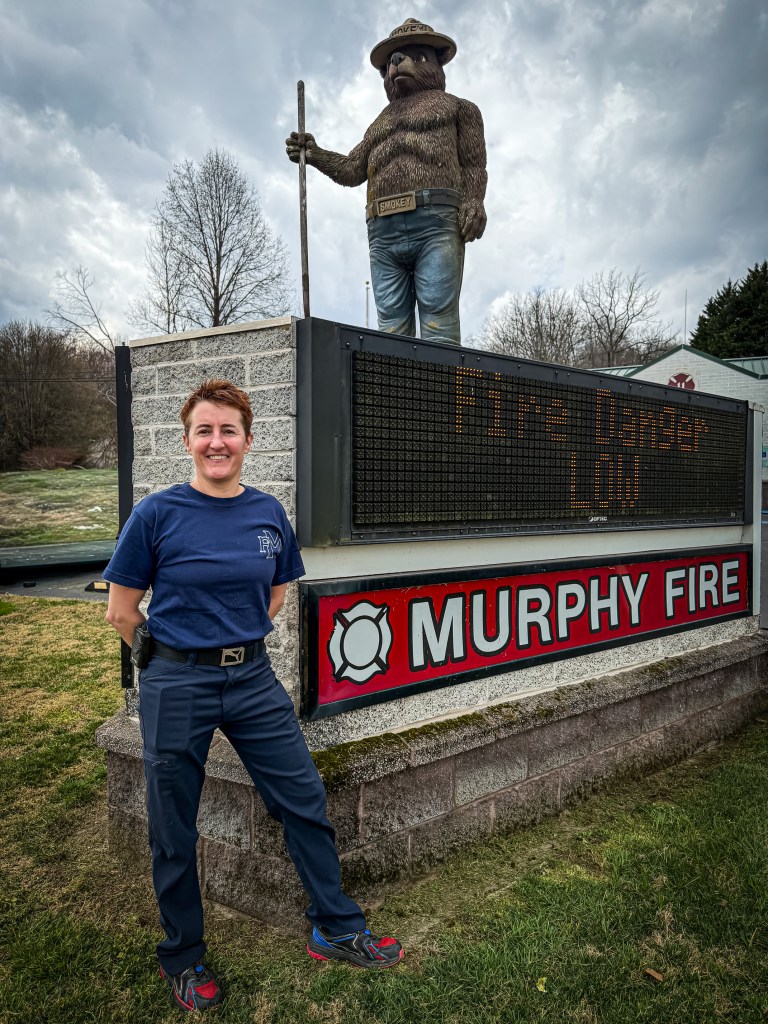
In October 2020, during covid, I was trying to find something extra to do, give back to the community. I saw the advertisement on Facebook looking for volunteers for Grape Creek Fire Department. Come to find out that the chief there was Alan Andrews, who’s also English, and from London, where I am from. That was the beginning. My husband, Eric Schechter, wasn’t interested. He just was going to go along with me as moral support, but Alan said, “you know, if there’s a call, you’re going to want to go, too.” So that’s how Eric also ended up becoming a volunteer firefighter.
If I can help somebody on their worst day make it a little bit better that’s worth everything.
–Zoe Schechter
We went to school during covid and realized there was a lot more to firefighting than putting, what we call “the wet stuff on the hot stuff.” We realized that there’s really a technique to this, and we’d probably be good to learn what that technique is. They were offering free classes. If you were affiliated with a fire department, you could take them. So, we did Tuesday, Thursday, and every other weekend. We learned everything from the history of firefighting to actually going into the burning building, practicing runs, and putting fires out. It took over a year to just get that training. I remember at that time thinking “why am I doing this? Why am I volunteering, volunteering for this?” But, the accomplishment at the very end was worth it.
We have since switched to Murphy Fire Department. As soon as I moved here, it just felt familiar. It felt like a home away from home. I love being in the woods. I love the outdoors. I love playing in the creeks, and I love four seasons. I love that it’s steeped in history, albeit somewhat sad. I love the history behind the families, the generations of families that are still here today. You’ve got a whole list of names, and as soon as you hear someone’s last name, you know that that’s a generational name. Eric and I were actually one of the first non-Murphyites to join the Murphy Fire Department, technically outsiders, especially me. You had a guy from Texas and a girl from England joining the department. I love how Murphy is still keeping that small town feel but growing and providing for the citizens.
One of my most vivid memories as a firefighter was an apartment fire. The apartments were built with two units underneath and two on top, and there was only one entrance and exit in the front porch area. Unfortunately, that’s where the fire had originated. By the time the first crew got there, there really wasn’t stairs, and there were reports of people trapped upstairs by the time I got there. Things were already happening. They had already set up water supply. They already had firefighters doing an interior attack. My first mindset when I got there was, what can I do to help, make sure they’ve got their tools and spare air cylinders. Hump hose. We call it line management. Doing anything you can. It could be a simple task of hilting a ladder. When you climb up a ladder someone’s always got to hilt that ladder for safety. So, my first thought is look at what I can do to help. Another fire fighter and myself were going through the lower floor, which had more water damage and smoke than fire. We were just doing a search, just making sure nobody was under a bed because there had been reports of animals. We’re just seeing what we can see. And in this particular apartment, we went back in the room and saw a dog cage, we pulled a blanket off of the cage. There was this dog just looking at us, like, “Hello. What’s going on?” All I can see around is, fire damage and just water, puddles of water. And this dog’s just wagging its tail. I’m a dog lover. We got the dog out; we’re running out with the dog. We got the dog out and everybody just wanted to pet the dog. I went back in and I found his dog bowl, and some treats. The dog was very, very grateful to receive those treats. He had more treats than he’s ever had. I did come to find out that the owner and dog got reunited, and he was very grateful, because he thought that his dog had perished in the fire.
Another memory is when we did a training burn at the Wells old family home. That was an interesting process. We went through the home. We cleaned everything out. There was a lot of old belongings that the parents had left. There were dry cleaning clothes in the closet. There was a history to it. We’re going to burn it down, but we’re very grateful for that, because it allowed us very unique training opportunities that we just don’t get in a burn building, because the burn building isn’t a house, it isn’t a home. We were able to set up some scenarios within the bedrooms, the living room, and the kitchen where you go in and you search a bedroom, and move on to the next room. Your main goal is to look for livable space first. That was a unique opportunity, like a wakeup call, but a realization that this is what any day we could deal with. That was a good experience.
It is a commitment to volunteer as a fire fighter. You are expected to be there for your community. Unfortunately, when we’re usually called, it’s for someone’s worst day. If I can help somebody on their worst day make it a little bit better then, to me, that’s worth everything. It could be as simple as finding a family photo after a house fire, or, finding something that’s been in the family for generations. Sometimes we can’t save a house from complete destruction, but I try to go in with the mindset of what can I do to help this person have a better day.
Most five departments require weekly or every other week meetings. They do training. Obviously, you need to be trained. It can be frustrating and emotional, a bit of a roller coaster at times. Some of the rural departments have older equipment, and that can require a lot of work behind the scenes. There’s a lot of outreach to the community. In the Grape Creek community, we would go out and do a Halloween Candy get together. We invited people to the station. We would go to community meetings and talk about smoke alarms. We really try to help them understand what a volunteer firefighter does. There’s a job for everybody. There’s a lot of administrative paperwork to be done. There’s a lot of upkeep: truck checks, equipment checks, making sure the chainsaws run, general upkeep around the station. You’re working with a great group of people. It’s a great opportunity. And the reality is, at the end of day you’re there when something bad happens, when something real happens, and it’s important to be prepared for that.
–Zoe Schechter, Murphy Fire Department
 Volunteer Stories WNC
Leave a comment